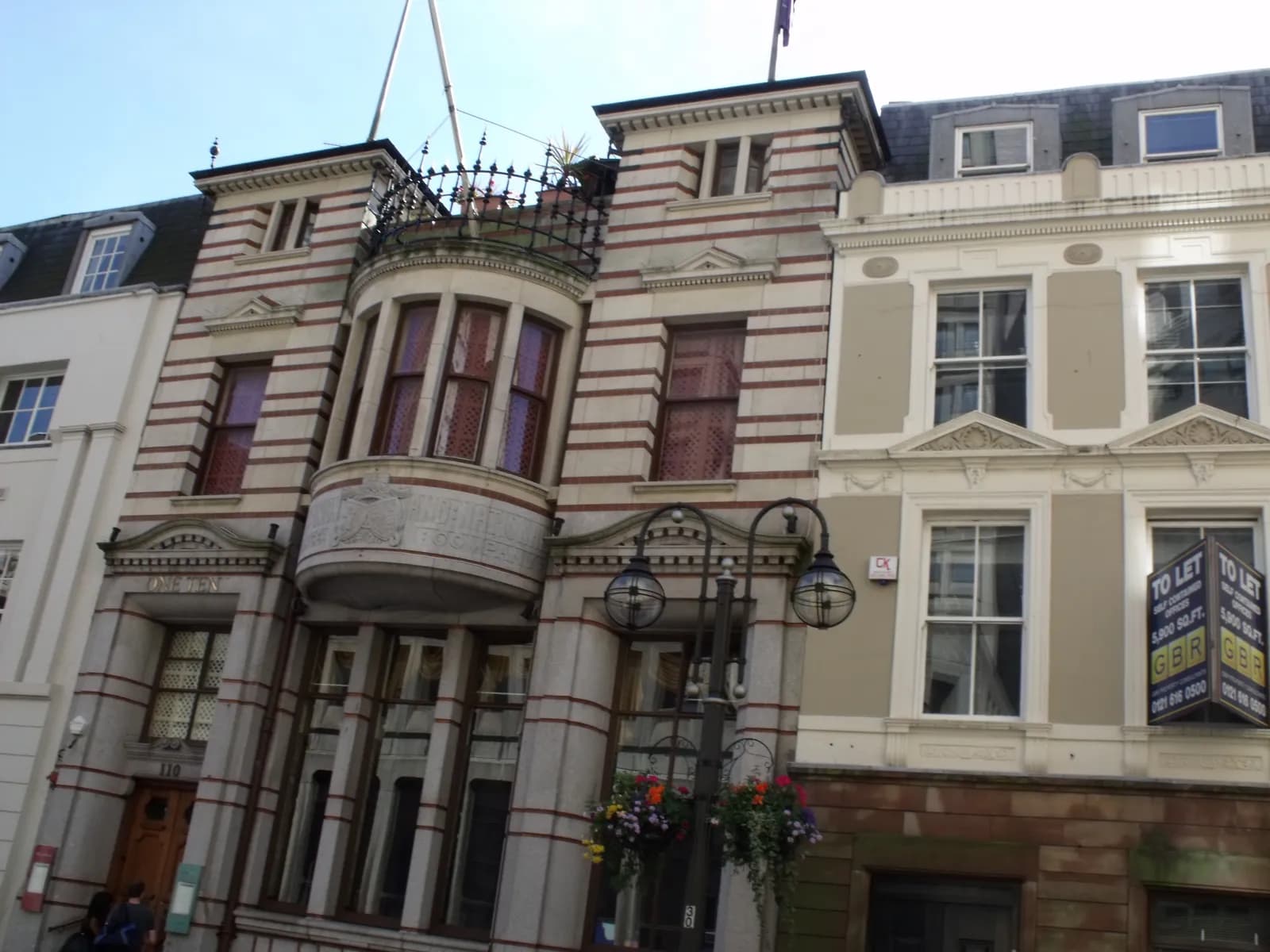
What Gives Aberdeen Granite Its Distinctive Gleam
The grey granite used across Aberdeen sparkles like silver because of its high mica content. Geologically, the stone belongs to igneous Diorite granites formed during the Dalradian period, roughly 480 to 600 million years ago. Granite is a coarse-grained intrusive igneous rock composed mainly of quartz, alkali feldspar, mica, and plagioclase; it is hard, tough, and nearly always massive, which made it ideal for construction.
From Rubislaw to Union Street: Building the Victorian City
From the mid-18th century through to the mid-20th century, Aberdeen's buildings incorporated locally quarried grey granite. Much of the Victorian fabric of the city was built with stone drawn from Rubislaw quarry, which finally ceased operation in 1971. The result is a city centre whose civic and commercial architecture is unified by a single, distinctive material.
Kemnay and the Global Reach of North-East Stone
Aberdeen was once the site of one of Britain's largest granite-exporting industries, shipping stone to projects across the world. In London, Aberdeen granite was used for the terraces of the Houses of Parliament, Waterloo Bridge, Kew Bridge, Putney Bridge, and the Thames Embankment. Closer to home, it supplied the Forth Railway Bridge in Edinburgh and the Cenotaph in Glasgow. The industry's reach extended as far as Australia, where workers from Kemnay quarry helped quarry and shape Australian granite for the Sydney Harbour Bridge. Kemnay masons also travelled to quarries in California, the Mississippi Levees, and Odessa.
Kemnay Quarry itself was opened by John Fyfe in 1830 and began commercial operation in 1858. Fyfe later invented the Blondin aerial ropeway system at Kemnay in 1872, an innovation that improved the movement of stone within the quarry.
The Architects Who Defined the Granite City
The transformation of Aberdeen into the "Granite City" was shaped by architects who worked with the material on a grand scale. Archibald Simpson designed many of the buildings along the new streets of King Street, George Street, and Union Street in the late 18th and early 19th centuries, and he began work on Marischal College in 1844. John Smith also designed numerous granite buildings along these same streets. Engineer Thomas Telford extended the North Pier in Aberdeen Harbour between 1810 and 1815. Marischal College is reputedly the world's largest granite building, while St Machar's Cathedral, begun in 1424, stands as a fortified granite structure, and the Neoclassical Music Hall dates from 1822.
A Legacy Set in Stone
Aberdeen is known as both the "Granite City" and the "Silver City by the Sea", the latter nickname deriving directly from the silvery sparkle of its local stone. The city's granite heritage remains visible in its most prominent civic buildings, including Aberdeen Town House, the administrative headquarters of Aberdeen City Council. While the city's primary industries today are oil and gas, tourism, and renewable energy, the granite legacy endures in the austere and impressive architecture that defines Aberdeen's streetscape.